


Quick Summary
- Interest is calculated using your qualifying deposits and the approved rate.
Example: KSh 500,000 × 8% = KSh 40,000 interest. - The Board proposes the rate after financial results are prepared.
Example: Board recommends 8% before AGM approval. - Members approve the rate during the AGM.
Example: AGM approves the proposed 8% interest. - Interest is usually paid once a year.
Example: Members receive payment after AGM approval. - Not all deposits may qualify for interest.
Example: A member who joined late may earn less. - Your deposit balance used for calculation depends on SACCO rules.
Example: Year-end balance of KSh 300,000 may be used. - Some SACCOs use average deposits during the year.
Example: Saving monthly may increase your qualifying balance. - Loan growth affects deposit interest.
Example: More well-performing loans can increase surplus. - Loan defaults reduce available returns.
Example: Unpaid loans reduce SACCO profits. - SACCOs keep some surplus as reserves.
Example: Part of profits goes into statutory reserves. - Deposit interest is not guaranteed every year.
Example: One year 10%, another year 7%. - Deposit interest may be taxed according to tax rules.
Example: SACCO deducts withholding tax before payment. - Members should look beyond one year’s interest rate.
Example: A stable SACCO may be better than one with a high but inconsistent payout. - Deposits held for the full year usually earn more interest.
Example: January savings earn more than December savings. - Withdrawals can reduce the interest earned.
Example: Reducing deposits from KSh 500,000 to KSh 200,000 lowers returns. - New members may earn interest only for the period their deposits qualify.
Example: Joining in July may earn half-year returns. - The final amount depends on AGM-approved policies.
Example: Members approve an 8% interest rate at AGM. - Higher deposits generally result in higher interest earnings.
Example: KSh 1 million earns more than KSh 100,000 at the same rate.
Simple Formula:
Deposit Interest = Qualifying Deposits × Approved Interest Rate
Example: KSh 250,000 × 10% = KSh 25,000 interest.
Have you ever looked at your SACCO statement and wondered why your deposit interest seems higher one year and lower the next, even though you kept saving consistently?
You're not alone.
Many SACCO members understand loan interest because they pay it every month. Deposit interest, however, often feels like a mystery. Some members even confuse it with dividends, expecting both to be calculated the same way. They are not.
Once you understand how SACCO deposit interest works, it becomes much easier to estimate your annual earnings, compare different SACCOs, and make smarter saving decisions.
What Is Interest on SACCO Deposits?
Deposit interest is the return a SACCO pays members for maintaining non-withdrawable deposits (sometimes called member deposits or shares, depending on the SACCO's terminology).
These deposits are different from:
- Ordinary savings accounts
- Fixed deposits
- Share capital
- Dividends paid on share capital
In most Kenyan deposit-taking SACCOs, member deposits form the pool of money used to issue loans to other members. Those loans generate interest income, and part of that surplus is later returned to members as interest on deposits.
Think of your deposits as helping finance the SACCO's lending activities. When the SACCO performs well financially, members usually benefit through higher interest payments.
How Is Deposit Interest Calculated?
The basic calculation is straightforward.
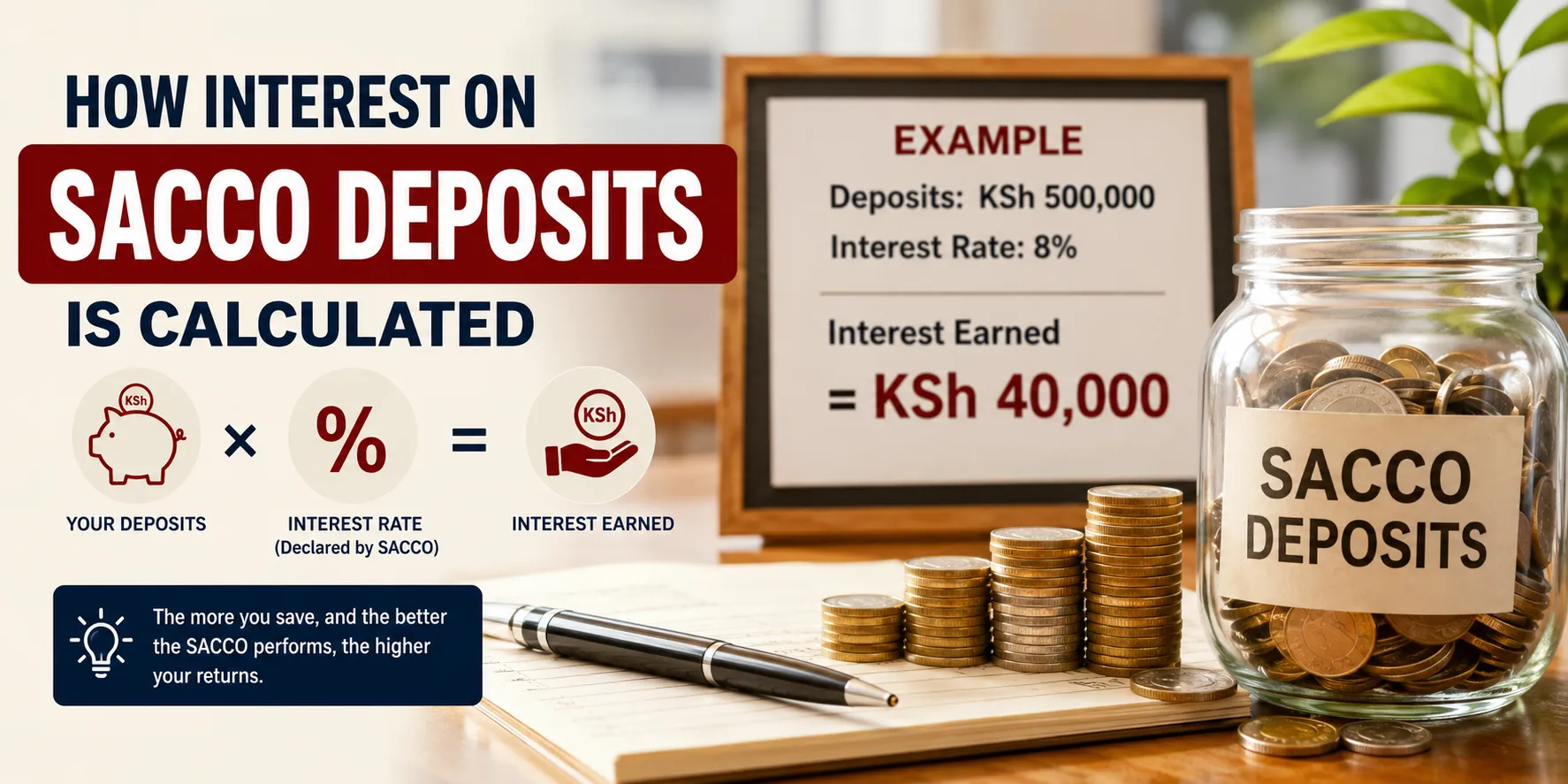
Deposit Interest = Your Qualifying Deposits × Approved Interest Rate
Suppose:
- Your member deposits: KSh 500,000
- SACCO deposit interest rate: 8%
Your interest would be:
KSh 500,000 × 8% = KSh 40,000
If your deposits were KSh 250,000 and the declared rate was 10%, you would receive:
KSh 25,000
The arithmetic is simple. Determining the interest rate is where things become more interesting.
Why Doesn't Every SACCO Pay the Same Rate?
A common misconception is that all SACCOs pay identical deposit interest because they operate under the same regulations.
That is not how the sector works.
Each SACCO declares its own rate after considering factors such as:
- Annual surplus
- Loan performance
- Operating expenses
- Bad debts
- Capital requirements
- Future investment plans
A SACCO that records strong loan repayments and healthy profits may declare an interest rate of 10% or more.
Another SACCO facing rising loan defaults or slower business growth might announce 6% or 7%.
The rate reflects financial performance rather than a fixed industry standard.
When Is the Interest Rate Decided?
Members sometimes expect to know the interest rate before the financial year ends.
In reality, the rate is normally proposed by the Board after the annual financial results are prepared and audited.
Members then approve the recommendation during the Annual General Meeting (AGM).
Only after approval does the SACCO credit members' accounts.
That explains why many members receive deposit interest once each year instead of every month.
Does Every Deposit Earn Interest?
Not necessarily.
Many SACCOs calculate interest using the closing deposit balance at the end of the financial year.
Others consider qualifying deposits accumulated throughout the year.
Each SACCO's bylaws and dividend policy determine the exact approach.
For example:
- Deposits transferred from monthly deductions usually qualify.
- Withdrawn deposits may reduce your earnings.
- Dormant accounts may have different treatment.
- New members joining late in the year may earn interest only on qualifying deposits.
Reality check: Two members with similar total deposits may receive different interest if one joined midway through the financial year or made withdrawals.
What Determines Whether Interest Will Be High or Low?
Several practical factors influence the final payout.
1. Loan Growth
Loans are the main income source for most SACCOs.
If lending activity is strong and members repay on time, the SACCO earns more interest income.
Higher income often creates room for better returns to members.
2. Loan Defaults
Late repayments and bad debts reduce available surplus.
Money that should have generated returns instead becomes difficult to recover.
On the ground, even a large SACCO can announce lower deposit interest if loan recovery becomes a challenge.
3. Operating Costs
Every SACCO pays for:
- Staff salaries
- Branch operations
- Technology systems
- Regulatory compliance
- Audits
Higher operating expenses leave less surplus available for distribution.
4. Reserve Requirements
Not all profits are shared immediately.
Cooperative laws and SACCO bylaws often require part of the surplus to be transferred into statutory reserves or other funds before members receive interest.
This strengthens the institution for future growth.
Is Deposit Interest Guaranteed?
No.
Unlike a bank account with a fixed savings rate, SACCO deposit interest depends on annual performance.
One year may produce an 11% return.
Another year could deliver 7%.
In difficult economic conditions, the rate could be even lower.
That's why experienced SACCO members pay attention to long-term consistency rather than celebrating a single high payout.
Is Deposit Interest Taxable?
Yes.
Deposit interest paid by SACCOs may be subject to applicable Kenyan tax laws.
The SACCO usually deducts any required withholding tax before crediting your account, depending on the nature of the payment and the prevailing tax rules.
Tax regulations can change over time, so members should confirm current treatment with their SACCO or a qualified tax adviser.
Deposit Interest vs Dividends
These two terms are frequently mixed up.
| Deposit Interest | Dividends |
|---|---|
| Paid on member deposits | Paid on share capital |
| Based on qualifying deposits | Based on shares owned |
| Supports the lending business | Rewards investment in share capital |
| Rate varies annually | Rate also varies annually |
A member may receive both payments if they hold qualifying deposits and share capital.
For a deeper explanation, read our guide on How SACCO Dividends Are Calculated.
Can You Estimate Your Expected Interest?
Yes, once your SACCO announces the proposed rate.
A quick estimate looks like this:
| Deposits | Interest Rate | Estimated Interest |
|---|---|---|
| KSh 100,000 | 8% | KSh 8,000 |
| KSh 250,000 | 8% | KSh 20,000 |
| KSh 500,000 | 8% | KSh 40,000 |
| KSh 1,000,000 | 8% | KSh 80,000 |
Remember that your actual payment depends on your SACCO's approved policy and qualifying deposit balance.
Common Mistakes Members Make
Some misunderstandings appear repeatedly during AGM discussions.
These include:
- Assuming deposit interest is paid every month.
- Confusing deposits with share capital.
- Expecting the same rate every year.
- Comparing two SACCOs without considering their financial performance.
- Ignoring the SACCO's bylaws on qualifying deposits.
Knowing the difference helps members set realistic expectations.
Reality: Bigger Deposits Usually Mean Bigger Returns
Members who consistently increase their deposits over several years generally earn more interest than those who maintain the minimum balance.
That does not mean chasing the highest advertised rate every year.
Financial stability, strong governance, quality loan management, and consistent performance often matter more than one exceptional payout.
Many long-serving SACCO members will tell you that steady growth over ten years usually delivers better value than moving from one SACCO to another in search of a slightly higher annual rate.
Final Thoughts
Interest on SACCO deposits is one of the ways members share in the success of their cooperative. The calculation itself is straightforward, but the amount you receive depends on far more than a published percentage. Loan performance, operating costs, reserves, and the decisions approved at the AGM all shape the final payout.
If you are evaluating a SACCO, don't focus only on last year's interest rate. Review its long-term financial performance, governance, and ability to generate sustainable surpluses. Those factors often provide a clearer picture of what members can expect over time.


