


Quick Summary
- SACCO dividend is a share of profit paid to members based on share capital.
Example: Own KSh 100,000 shares ? you may receive a dividend. - Dividends are calculated using a simple formula:
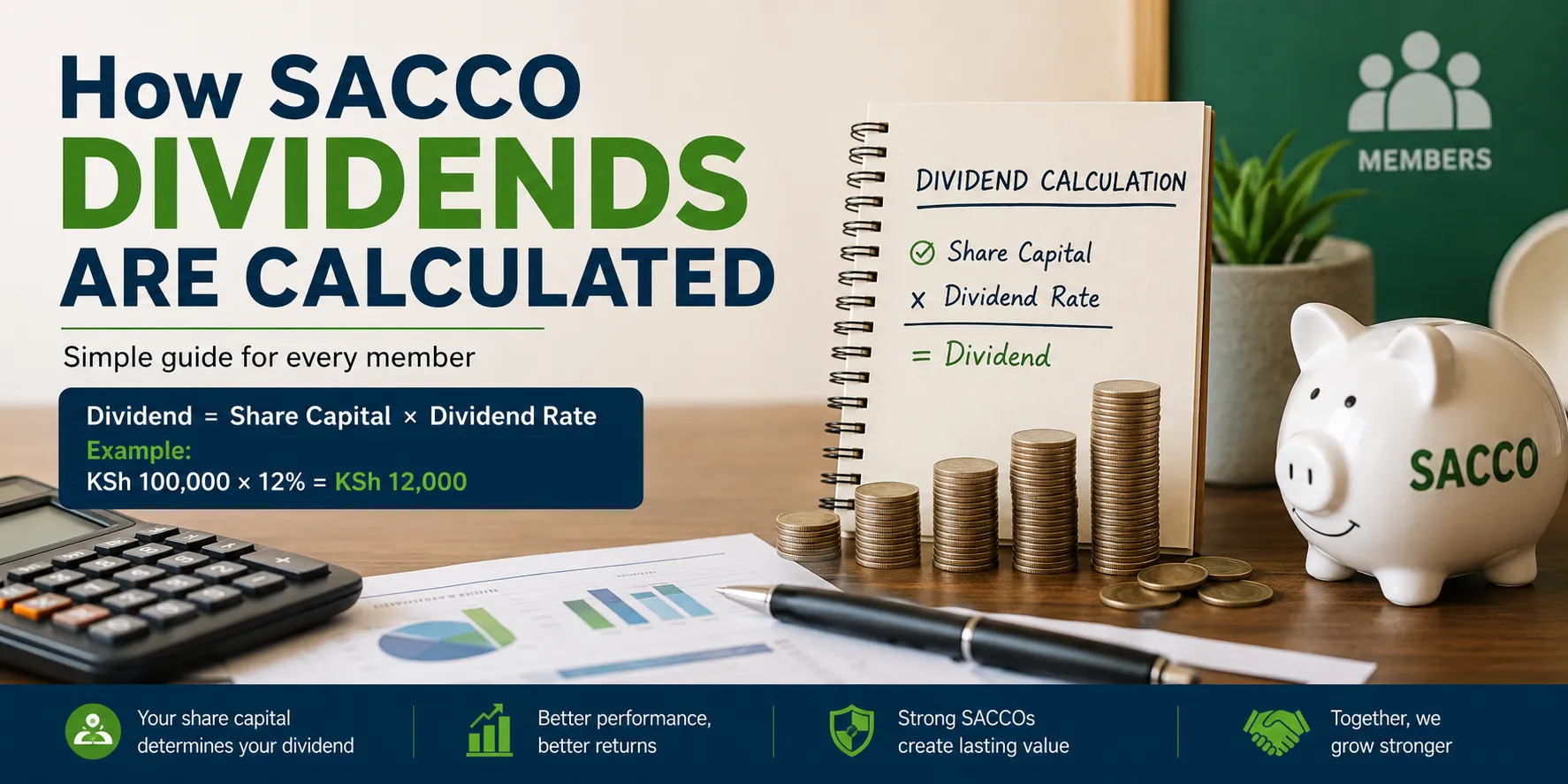
Dividend = Share Capital × Dividend Rate
Example: KSh 100,000 × 12% = KSh 12,000. - Dividend is based on share capital, not normal savings deposits.
Example: KSh 50,000 shares earn dividends, but KSh 500,000 deposits earn interest. - The dividend rate is decided after reviewing SACCO performance.
Example: A profitable year may allow a 12% dividend. - The Board recommends the dividend rate, but members approve it at the AGM.
Example: Members vote to approve a 10% dividend. - Higher share capital usually means higher dividends.
Example: KSh 300,000 shares earn more than KSh 30,000 shares at the same rate. - SACCO profits affect the dividend rate.
Example: Higher loan repayments may increase surplus available for dividends. - SACCOs cannot distribute all profits.
Example: Some money is kept for reserves and future growth. - Dividend rates can change every year.
Example: A SACCO may pay 15% one year and 10% the next. - A large loan does not automatically increase your dividend.
Example: Dividend depends on shares owned, not loan size. - Different SACCOs pay different dividend rates.
Example: SACCO A may pay 12%, while SACCO B pays 8%. - To increase potential dividends, build your share capital over time.
Example: Increasing shares from KSh 50,000 to KSh 100,000 doubles the dividend base. - A high dividend rate does not always mean a better SACCO.
Example: A SACCO keeping reserves may be stronger in the long term. - Always check financial performance, governance, and stability—not just dividends.
Example: A SACCO with steady growth may be safer than one with a one-time high payout.
Have you ever received a dividend payment from your SACCO and wondered, "How did they arrive at this figure?" You're not alone.
Every year, thousands of SACCO members across Kenya eagerly wait for dividend announcements after the Annual General Meeting (AGM). Some members receive substantial payouts, while others are surprised that their dividend is much lower than expected—even though they have been saving consistently.
The difference usually comes down to one thing: understanding how SACCO dividends are actually calculated.
Once you know the formula, it becomes much easier to estimate your earnings, plan your savings, and avoid unrealistic expectations. Here's a practical guide to how the process works.
What Is a SACCO Dividend?
A SACCO dividend is a share of the surplus (profit) that a SACCO distributes to members based on the share capital they own.
Think of yourself as a part-owner of the SACCO. When the SACCO performs well financially, part of the surplus may be shared among members after meeting operating expenses, setting aside reserves, and satisfying regulatory requirements.
Unlike interest earned on deposits, dividends are linked to share capital, not your monthly savings.
How SACCO Dividends Are Calculated
The calculation is actually straightforward.
Formula
Dividend = Share Capital × Dividend Rate
For example:
- Share Capital: KSh 100,000
- Declared Dividend Rate: 12%
Calculation:
KSh 100,000 × 12% = KSh 12,000
That means the member receives KSh 12,000 as dividends for the year.
The higher your share capital, the larger your dividend payment will be—provided the SACCO declares a dividend.
Where Does the Dividend Rate Come From?
This is one area that often causes confusion.
A SACCO does not choose a dividend rate at random.
Before any dividends are declared, the SACCO must:
- Prepare its annual financial statements.
- Determine the surplus earned during the year.
- Meet statutory reserve requirements.
- Pay operating expenses.
- Make provisions required by regulators.
- Obtain approval from members during the AGM.
Only then can the Board recommend a dividend rate for approval.
For example, a SACCO may announce:
- 8% dividend
- 10% dividend
- 15% dividend
The rate depends largely on how well the SACCO performed financially during that year.
In practice, even well-managed SACCOs sometimes declare a lower dividend than the previous year if economic conditions reduce profitability.
Share Capital vs Deposits: Know the Difference
Many members mistakenly assume all their savings earn dividends.
That is not the case.
| Share Capital | Member Deposits |
|---|---|
| Earns dividends | Earn interest on deposits |
| Usually permanent while you're a member | Can increase every month |
| Represents ownership | Represents savings |
Suppose you have:
- Share Capital: KSh 50,000
- Deposits: KSh 600,000
If the SACCO declares:
- Dividend: 12%
- Interest on Deposits: 8%
You will receive:
Dividend:
KSh 50,000 × 12%
= KSh 6,000
Interest on deposits:
KSh 600,000 × 8%
= KSh 48,000
Although the interest payment is larger, it is not considered a dividend because it is calculated differently.
You may also like:
- What Is the Difference Between SACCO Share Capital and Deposits?
- How Interest on SACCO Deposits Is Calculated
What Determines How Much Dividend You Receive?
Several factors affect your final payout.
1. Your Share Capital
This is the biggest factor.
Members with more share capital receive higher dividends because dividends are proportional to ownership.
For example:
| Share Capital | Dividend Rate | Dividend |
|---|---|---|
| KSh 20,000 | 10% | KSh 2,000 |
| KSh 100,000 | 10% | KSh 10,000 |
| KSh 300,000 | 10% | KSh 30,000 |
2. SACCO Financial Performance
If profits increase, members may receive better dividends.
If profits fall, dividend rates often decline.
A strong loan book, timely loan repayments, and prudent financial management all contribute to healthier returns.
3. Regulatory Requirements
SACCOs cannot distribute all their profits.
They must retain part of the surplus for:
- Statutory reserves
- Capital growth
- Risk management
- Future investments
This protects members and strengthens the institution over the long term.
4. AGM Approval
Even after the Board proposes a dividend rate, members must approve it during the Annual General Meeting.
This ensures accountability and transparency in the distribution of surplus.
A Practical Example
Imagine Green Farmers SACCO reports a healthy financial year.
The AGM approves:
- Dividend Rate: 14%
Three members have different share capital balances.
| Member | Share Capital | Dividend |
|---|---|---|
| Alice | KSh 30,000 | KSh 4,200 |
| Brian | KSh 100,000 | KSh 14,000 |
| Carol | KSh 250,000 | KSh 35,000 |
Notice that everyone receives the same dividend rate, but the actual amount depends entirely on the share capital owned.
Why Dividend Rates Change Every Year
Members sometimes ask why last year's dividend was 15%, yet this year it dropped to 11%.
There are many possible reasons:
- Lower loan demand
- Higher loan defaults
- Increased operating costs
- Economic slowdown
- Regulatory changes
- More money retained for future growth
On the ground, many SACCOs also invest in technology, new branches, or digital services. Those investments can reduce the surplus available for immediate distribution, even if they strengthen the institution over time.
Common Misunderstandings About SACCO Dividends
Here are a few myths worth clearing up.
"The dividend rate is guaranteed."
No.
It depends on annual performance and member approval.
"All my savings earn dividends."
Only share capital earns dividends.
Deposits usually earn interest instead.
"A bigger loan means higher dividends."
Loan size does not determine your dividend.
Dividends are based on share capital.
"Every SACCO pays the same dividend."
Different SACCOs have different financial results, governance practices, and growth strategies. Dividend rates therefore vary from one institution to another.
How to Maximise Your Dividend
While no dividend is guaranteed, there are sensible ways to improve your potential earnings over time.
- Build your share capital where your SACCO allows additional shares.
- Stay active as a member.
- Borrow responsibly and repay loans on time.
- Support a financially healthy SACCO with sound governance.
- Read the annual financial statements before the AGM.
Small increases in share capital can translate into noticeably higher dividends over several years.
Reality Check: Higher Dividends Are Not Always Better
A SACCO announcing the highest dividend in the market may attract attention, but that number alone does not tell the whole story.
A well-managed SACCO also needs enough retained earnings to grow, invest in better services, and cushion itself against future risks. Paying out nearly all available surplus might look attractive today, yet it could limit long-term stability.
As a member, it is worth looking beyond the headline dividend rate. Financial strength, governance, loan quality, and consistent performance matter just as much.
Final Thoughts
Understanding how SACCO dividends are calculated helps you interpret your annual payout with greater confidence. The calculation itself is simple: your share capital is multiplied by the dividend rate approved by members. What is less obvious is everything that happens before that rate is declared—from financial performance and regulatory obligations to decisions made at the AGM.
Rather than comparing dividend rates alone, consider the bigger picture. A financially sound SACCO that delivers steady returns year after year often provides greater long-term value than one chasing impressive figures for a single season.


