


Quick Summary
- Deposits = Your savings in the SACCO
- Example: Save KSh 5,000 every month.
- Share capital = Your ownership in the SACCO
- Example: Buy shares worth KSh 20,000.
- Deposits help determine loan eligibility
- Example: KSh 300,000 deposits × 3 = KSh 900,000 loan.
- Share capital usually does not increase your loan limit
- Example: KSh 20,000 shares may not increase borrowing.
- Deposits may earn interest
- Example: SACCO pays returns on member savings.
- Share capital may earn dividends
- Example: Members receive dividends after AGM approval.
- Deposits are mainly for savings and lending
- Example: SACCO uses deposits to give loans.
- Share capital shows member ownership
- Example: Member can vote at AGM.
- Deposits can usually be refunded when leaving (with conditions)
- Example: Resign and clear loans first.
- Share capital is normally refunded after exit
- Example: Shares returned after completing SACCO procedures.
- Both balances belong to the member but have different purposes
- Example: One builds savings, one proves ownership.
- Increasing deposits can improve borrowing power
- Example: Higher deposits = higher possible loan.
- Increasing share capital beyond the minimum may not help loans
- Example: Extra shares mainly increase ownership.
- Returns are not guaranteed
- Example: Dividends depend on SACCO profits.
- Members should read SACCO rules before withdrawing money
- Example: Check by-laws before resigning.
- Simple example:
- Example: James has KSh 60,000 deposits + KSh 20,000 shares.
- Loan considers mainly KSh 60,000 deposits; dividends consider KSh 20,000 shares.
Have you ever looked at your SACCO statement and wondered why it shows share capital and deposits as two separate balances?
You're not alone. Many members assume they mean the same thing because both involve money they have contributed to the SACCO. The confusion usually becomes obvious when someone applies for a loan, transfers membership, or plans to resign from a SACCO. Suddenly, they discover that one balance can be withdrawn under certain conditions while the other cannot.
That distinction matters. Understanding it helps you make better financial decisions, avoid disappointment, and know exactly what your money is doing inside the SACCO.
What Are SACCO Deposits?
Deposits, sometimes called member deposits or deposit contributions, are the savings you make regularly after joining a SACCO.
Most Kenyan SACCOs require members to contribute a minimum amount every month. Depending on the SACCO, this could be KSh 1,000, KSh 3,000, KSh 5,000, or even more.
These deposits serve several purposes:
- Build your savings over time.
- Determine how much you can borrow.
- Earn annual interest in many SACCOs.
- Strengthen the SACCO's lending pool.
Think of deposits as your growing savings account within the SACCO. The more consistently you contribute, the stronger your borrowing capacity usually becomes.
Reality check: Many members focus only on qualifying for a loan. Experienced SACCO members also pay attention to growing their deposits because they often generate annual returns and increase future borrowing power.
What Is SACCO Share Capital?
Share capital is your ownership contribution to the SACCO.
Unlike deposits, share capital represents your investment as a member-owner rather than your savings.
Every SACCO sets a minimum share capital requirement. Some require KSh 10,000, while others may require KSh 20,000, KSh 50,000, or more. Members usually build this amount gradually if they cannot pay it all at once.
Owning share capital gives you rights such as:
- Membership ownership.
- Voting during Annual General Meetings (AGMs).
- Eligibility for leadership positions (subject to SACCO rules).
- Receiving dividends when declared.
Unlike deposits, share capital is generally intended to remain invested in the SACCO for as long as you remain a member.
On the ground, many new members only discover this after asking to withdraw their share capital. They are surprised to learn that it isn't treated like ordinary savings.
The Biggest Difference
The easiest way to understand the two is by looking at their purpose.
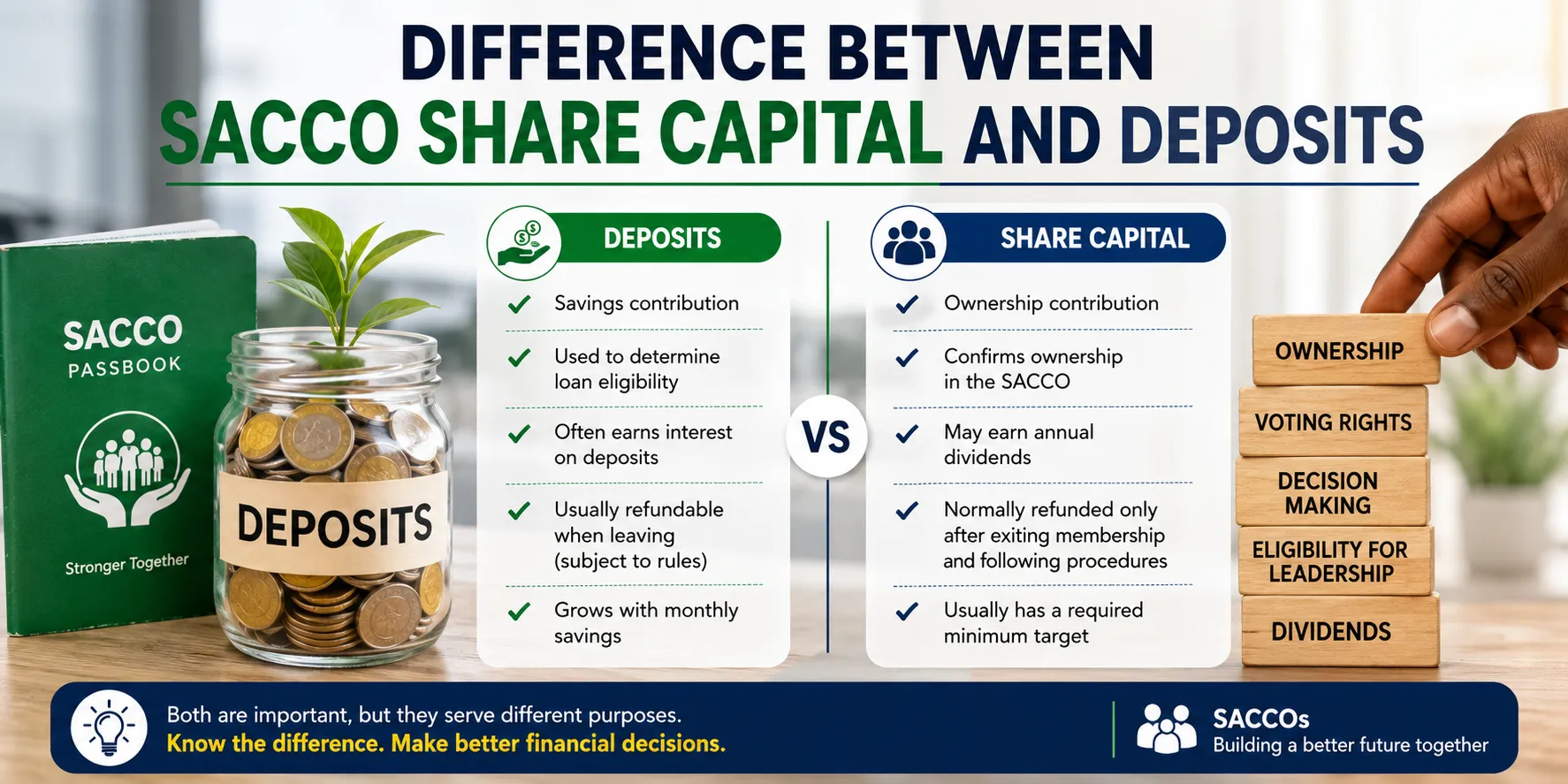
| SACCO Deposits | SACCO Share Capital |
|---|---|
| Savings contribution | Ownership contribution |
| Used to determine loan eligibility | Confirms ownership in the SACCO |
| Often earns deposit interest | May earn annual dividends |
| Usually refundable when leaving (subject to rules) | Normally refunded only after exiting membership and following SACCO procedures |
| Grows with monthly savings | Usually has a required minimum target |
Although both belong to the member, they serve different functions within the SACCO.
How They Affect Your Loan Limit
One of the most practical differences appears when borrowing.
Most deposit-taking SACCOs calculate your maximum loan based largely on your deposits.
For example:
- Deposits: KSh 300,000
- Loan multiplier: 3 times deposits
Maximum loan:
KSh 900,000
Your share capital normally does not determine this loan limit.
Every SACCO has its own lending policy, so the formula may differ, but deposits are almost always a major factor.
In practice, increasing your monthly deposits usually has a much bigger impact on future borrowing than increasing share capital beyond the required minimum.
Which One Earns Returns?
This is another area where members get confused.
Generally:
- Deposits may earn interest on deposits.
- Share capital may earn dividends.
These are not the same thing.
Deposit interest is paid because your savings help finance loans.
Dividends are paid because you are an owner of the SACCO.
Both depend on the SACCO's financial performance and approval during the Annual General Meeting.
One year may produce attractive returns, while another may produce lower returns if business performance declines.
Can You Withdraw Them Anytime?
This question comes up frequently.
Deposits
Deposits are generally not available for everyday withdrawal like money in a bank savings account.
If you resign from the SACCO, your deposits are usually refunded after completing the required notice period and clearing any outstanding obligations.
Share Capital
Share capital is even less flexible.
It normally remains invested while you are a member. If you exit the SACCO, the refund follows the society's by-laws and applicable procedures.
Because policies vary, always check your SACCO's membership terms before assuming when payments will be released.
Why SACCOs Keep Them Separate
Keeping deposits and share capital separate isn't simply an accounting exercise.
Each serves a different purpose.
Deposits provide funds that the SACCO can lend to members.
Share capital strengthens the financial foundation of the institution and demonstrates member ownership.
This separation also helps regulators, auditors, and members clearly understand the SACCO's financial position.
A Simple Example
Imagine James joins a SACCO.
During his first year:
- Monthly deposits: KSh 5,000
- Total deposits after one year: KSh 60,000
- Share capital paid: KSh 20,000
When loan applications are considered, the SACCO mainly looks at the KSh 60,000 deposits and any applicable multiplier.
When dividends are declared, the KSh 20,000 share capital may qualify for dividends according to the SACCO's approved rate.
The two balances sit in the same member account, but they perform completely different roles.
Common Misunderstandings
Many SACCO members believe:
- Share capital and deposits are the same.
- All contributions increase loan limits.
- Both can be withdrawn whenever needed.
- Dividends and deposit interest are identical.
Those assumptions often lead to disappointment, especially when members plan to leave a SACCO or expect larger loan limits than they actually qualify for.
Reading your SACCO's by-laws and asking questions before making financial decisions can prevent these surprises.
Reality vs Theory
| Theory | Reality |
|---|---|
| All money paid into a SACCO is savings. | Contributions are usually split into different categories with different purposes. |
| More share capital always means a bigger loan. | Deposits usually have a greater influence on borrowing limits. |
| Dividends are guaranteed every year. | Returns depend on financial performance and approval by members. |
| Members can withdraw contributions whenever they wish. | SACCO by-laws normally set conditions and timelines for refunds. |
Final Thoughts
Knowing the difference between SACCO share capital and deposits makes it much easier to understand your membership and manage your expectations.
Deposits help build your savings, strengthen your borrowing capacity, and may earn deposit interest. Share capital, on the other hand, represents your ownership stake and may qualify for dividends if the SACCO performs well.
Before increasing contributions, applying for a loan, or planning to exit a SACCO, take time to understand how your particular SACCO treats each category. A few minutes spent reading the by-laws or speaking with your SACCO's member services team can save months of confusion later.


