


Quick Summary
- Always verify the recipient before sending money. (Example: Confirm "John Mwangi" appears before sending KSh 5,000.)
- Don't trust payment screenshots alone. (Example: Check your M-PESA statement before handing over goods.)
- Be aware of transaction charges. (Example: Several small transfer fees can add up each month.)
- Avoid making payments on public Wi-Fi. (Example: Use mobile data instead of café Wi-Fi.)
- Use strong, unique passwords. (Example: Don't use the same password for email and banking.)
- Keep payment records. (Example: Save receipts for supplier payments.)
- Verify changes to payment details. (Example: Call your supplier before using a new bank account.)
- Review your account regularly. (Example: Spot an unfamiliar KSh 1,200 transaction early.)
- Report mistakes immediately. (Example: Contact your bank or mobile money provider as soon as you notice an error.)
- Build safe payment habits. (Example: Spend 10 extra seconds checking details before tapping "Send.")
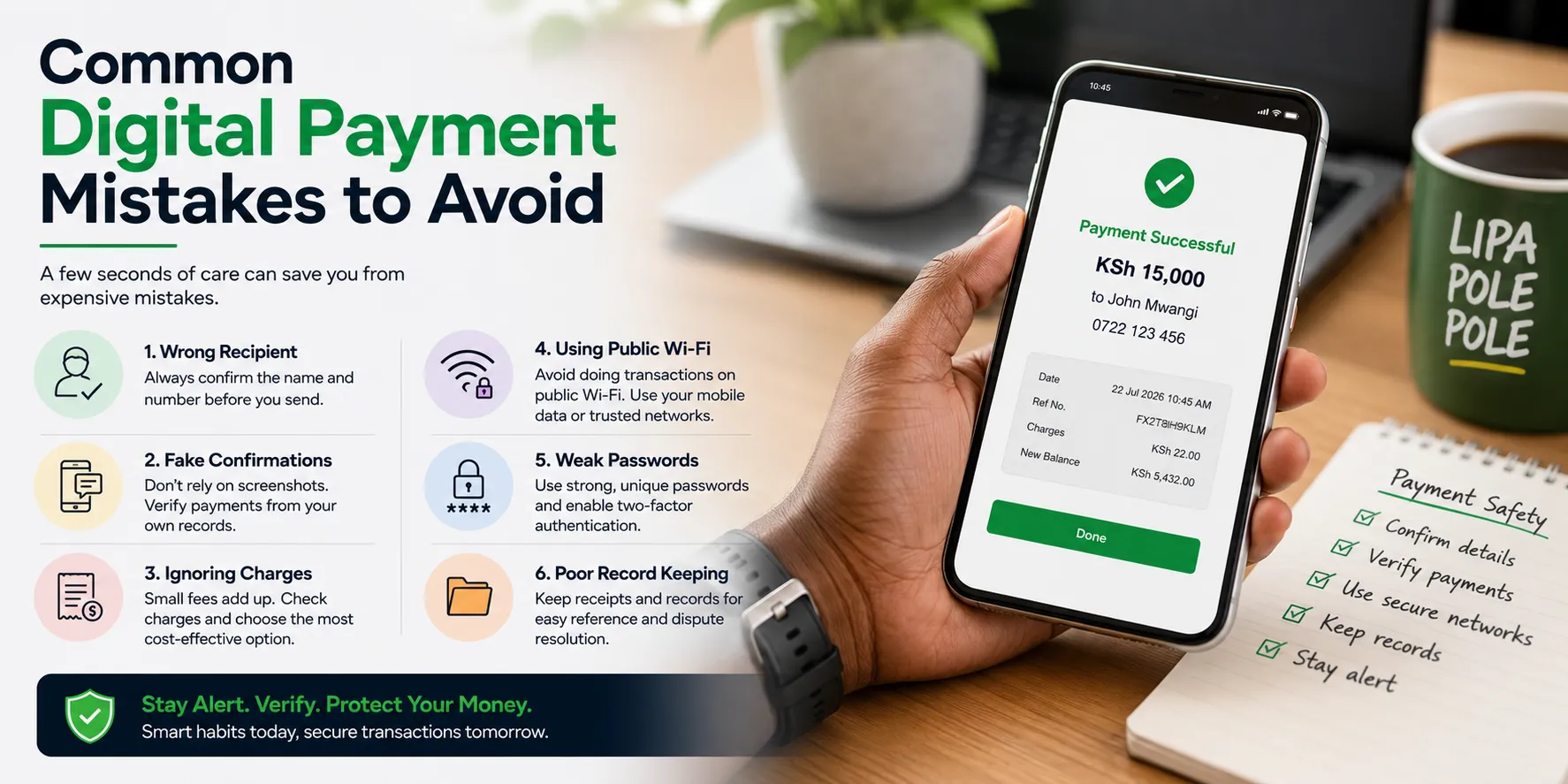
Have You Ever Sent Money to the Wrong Number?
It only takes a few seconds.
You open your phone, enter an amount, tap Send, and then your heart sinks. The confirmation message arrives, but the recipient's name isn't the one you expected. If you've used M-PESA, bank transfers, Airtel Money, or online payment platforms long enough, you've probably experienced that moment—or know someone who has.
Digital payments have become part of everyday life in Kenya. From paying matatu fares and buying groceries to settling supplier invoices and receiving customer payments, cash is no longer the only option. Convenience, however, has also created new opportunities for costly mistakes.
Most payment errors aren't caused by technology failing. They usually happen because people rush, skip simple checks, or misunderstand how digital payment systems work.
What Digital Payment Mistakes Mean
A digital payment mistake is any avoidable action that results in money being delayed, sent incorrectly, exposed to fraud, or becoming difficult to recover.
Sometimes the loss is only a few hundred shillings. Other times, businesses lose thousands because an invoice was paid to the wrong account or an employee fell for a fake payment request.
The encouraging part is that many of these mistakes can be prevented through better habits rather than expensive software.
Why It Matters
Kenya has one of Africa's most active digital payment ecosystems. Mobile money, internet banking, payment apps, QR payments, and online shopping have become normal for millions of people.
That level of convenience also means people process dozens of transactions every week without giving each one much thought.
For individuals, a single mistake can disrupt a monthly budget.
For small businesses, repeated payment errors can damage customer trust, strain cash flow, create accounting headaches, and consume valuable time trying to reverse transactions.
A few extra seconds before confirming a payment can sometimes prevent days of unnecessary follow-up.
Practical Breakdown
1. Sending Money Without Confirming the Recipient
This remains one of the most common mistakes.
Someone calls asking for payment, you type the phone number quickly, and press send before carefully reading the confirmation screen.
In practice, many people rely on recognizing the first few digits of a phone number instead of checking the recipient's full name.
Before confirming any payment:
- Read the displayed recipient name.
- Verify the phone number or account number.
- If you're paying a supplier for the first time, confirm the details through another communication channel.
Those few seconds are often worth more than the money at risk.
2. Falling for Fake Payment Confirmation Messages
Many business owners have encountered this situation.
A customer shows an SMS claiming payment has been made. Without checking the business phone or official statement, goods are handed over immediately.
Unfortunately, fake confirmation messages have become increasingly convincing.
The safest approach is simple:
Only release goods or provide services after confirming the payment through your own records, payment app, bank notification, or merchant account.
A screenshot or forwarded SMS should never be treated as proof of payment by itself.
3. Ignoring Transaction Charges
Small fees may not seem significant until they accumulate.
Someone transferring money several times each day may spend far more on charges than expected over the course of a month.
Businesses handling supplier payments, salary advances, or customer refunds can particularly feel the impact.
Reviewing payment costs regularly helps identify whether another payment method would reduce expenses.
4. Using Public Wi-Fi for Financial Transactions
Free internet at cafés, hotels, airports, or shopping centres is convenient.
It is not always the safest place to access banking services.
Public networks may expose users to unnecessary security risks, especially if the connection is unsecured.
Whenever possible, complete financial transactions using your mobile data or a trusted private network.
If public Wi-Fi is unavoidable, avoid logging into banking or payment applications until you're on a secure connection.
5. Reusing Weak Passwords Everywhere
Many people use the same password for email, banking apps, shopping websites, and business accounts.
That creates a chain reaction.
If one account becomes compromised, attackers often try the same password elsewhere.
A stronger approach includes:
- Using unique passwords for important accounts.
- Enabling two-factor authentication where available.
- Updating passwords periodically, especially after any security concern.
6. Not Keeping Payment Records
Some people assume transaction history will always remain available.
Months later, they struggle to prove payment during a dispute.
Business owners should keep proper records of:
- Payment receipts
- Bank statements
- Mobile money confirmations
- Customer invoices
- Supplier payment references
Good record-keeping saves time during tax preparation, audits, and customer queries.
7. Paying Invoices Without Verifying Account Changes
Cybercriminals increasingly target businesses through invoice fraud.
An email appears to come from a supplier saying, "Please use our new bank account for future payments."
Without verification, the payment goes to criminals instead.
If payment details suddenly change, contact the supplier using a known phone number—not the contact information provided in the suspicious email.
Independent verification remains one of the simplest ways to prevent invoice fraud.
8. Ignoring Regular Account Reviews
People often notice fraudulent transactions weeks after they occurred.
By then, recovering funds becomes much harder.
Checking payment history regularly allows unusual activity to be spotted early.
Even spending five minutes each week reviewing bank statements or mobile money records can make a noticeable difference.
Reality Check
Digital payment systems are generally reliable and continue to improve every year.
The technology itself is rarely the biggest problem.
However, on the ground, human behaviour tells a different story. People multitask while making payments, trust screenshots without verification, rush through confirmation screens, or assume every message they receive is genuine.
Another misconception is that banks or mobile money providers can always reverse mistaken transactions.
Reality is more complicated.
Some transactions can be reversed quickly if reported immediately. Others cannot, particularly when funds have already been withdrawn or transferred onward.
That is why prevention remains more effective than trying to recover money afterward.
Practical Takeaways
If you regularly use digital payments, build a few habits into every transaction:
- Pause before pressing the final confirmation button.
- Verify recipient names instead of relying only on phone numbers.
- Confirm payments using official transaction records rather than screenshots.
- Use strong, unique passwords and enable two-factor authentication.
- Keep receipts for important personal and business payments.
- Review account activity frequently to detect unusual transactions early.
- Verify any request to change payment details through a trusted contact method.
These steps require very little time but can prevent expensive mistakes.
Common Questions or Misconceptions
"If I send money to the wrong person, will I always get it back?"
Not necessarily. Recovery depends on how quickly the mistake is reported, the payment provider's procedures, and whether the recipient has already accessed the funds.
"A payment screenshot is enough proof."
Not always. Screenshots can be edited or fabricated. Official payment confirmations from your own account are much more reliable.
"Fraud only affects large businesses."
Small businesses are frequently targeted because criminals often assume they have fewer security controls.
"Strong passwords are enough."
Passwords are only one layer of protection. Two-factor authentication, secure devices, and careful verification of payment requests all play important roles.
Conclusion
Digital payments have transformed how Kenyans buy, sell, save, and run businesses. They are faster than carrying cash and often far more convenient. Even so, convenience should never replace careful verification.
Most costly payment mistakes happen during ordinary, everyday transactions rather than sophisticated cyberattacks. Taking a moment to confirm recipient details, reviewing payment records, and questioning unexpected requests may seem like small habits, yet they often make the biggest difference. As digital finance continues to grow across Kenya, careful users will benefit not only from speed but also from greater confidence that their money is reaching the right destination.


