


Quick Summary
- Inflation means prices rise over time. Example: Bread costs KSh 70 instead of KSh 60.
- High demand can push prices up. Example: More people buy cooking oil than shops have.
- Higher production costs increase prices. Example: A bakery pays more for flour and electricity.
- Fuel prices affect almost everything. Example: Higher diesel prices increase transport costs.
- Supply shortages make goods more expensive. Example: Drought reduces maize harvests, raising unga prices.
- A weaker shilling makes imports cost more. Example: Imported electronics become more expensive.
- Taxes can increase prices. Example: Higher fuel taxes raise transport fares.
- More money in circulation may fuel inflation. Example: Spending rises faster than production.
- Future expectations can affect prices today. Example: A wholesaler raises prices expecting higher costs next month.
- Inflation reduces purchasing power. Example: KSh 1,000 buys fewer groceries than last year.
- Businesses adjust prices to survive. Example: A restaurant increases meal prices after food costs rise.
- Consumers can reduce the impact by budgeting wisely. Example: Comparing prices before shopping saves money.
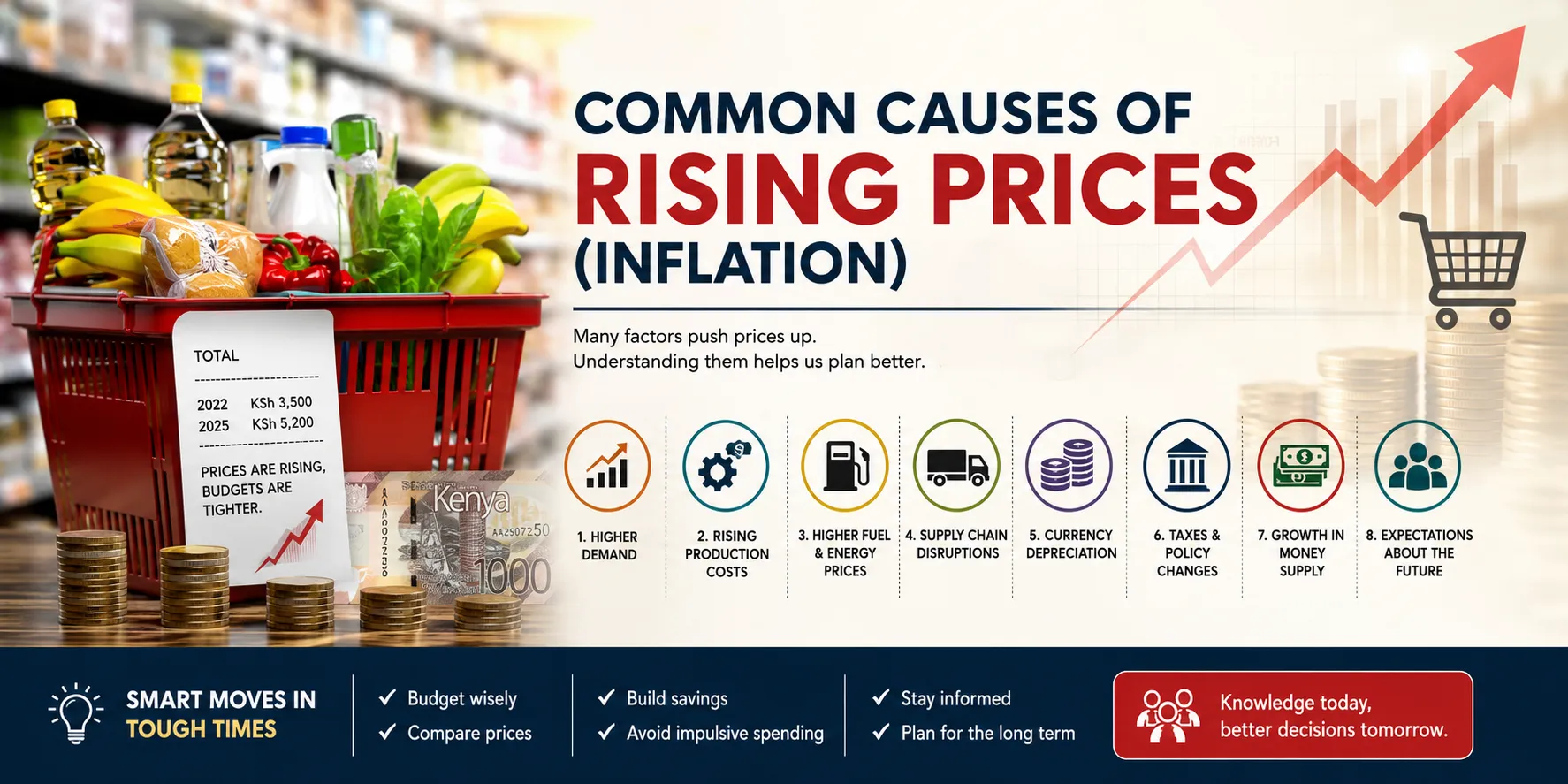
Have You Ever Wondered Why the Same Money Buys Less Every Year?
A few years ago, KSh 1,000 could comfortably cover several household essentials at a local supermarket. Today, many Kenyan families walk into the same store with the same amount and leave with fewer items. Matatu fares go up after fuel prices increase. A cup of tea at a neighborhood café quietly becomes more expensive. Even construction materials that seemed affordable a few months ago suddenly cost much more.
Most people simply say, "Things have become expensive."
What is actually happening is inflation—the gradual rise in the general prices of goods and services over time. While inflation affects nearly everyone, the reasons behind it are often misunderstood. It is rarely caused by a single event. Instead, several economic forces usually combine to push prices upward.
Understanding these causes helps households plan better, businesses make smarter decisions, and investors avoid costly mistakes.
What Inflation Means
Inflation is the rate at which the average price of goods and services increases over a period of time. As prices rise, the purchasing power of money falls. In simple terms, each shilling buys fewer goods than it did before.
Not every price increase qualifies as inflation. If tomatoes become expensive because heavy rains damaged crops while everything else remains stable, that is a temporary supply issue. Inflation occurs when price increases spread across many sectors of the economy over time.
The Kenya National Bureau of Statistics (KNBS) measures inflation using a basket of commonly purchased goods and services, including food, housing, transport, education, healthcare, and other everyday expenses.
Why It Matters
Inflation influences almost every financial decision people make.
Employees may discover that salary increases do not keep pace with the rising cost of living. Business owners face higher operating expenses and must decide whether to absorb the costs or pass them on to customers. Savers earn less in real terms if their savings grow more slowly than prices.
A retired person living on fixed income often feels inflation more sharply than someone whose earnings increase regularly. Small businesses with tight profit margins can also struggle when suppliers raise prices unexpectedly.
For these reasons, inflation is not just an economic statistic—it directly affects daily life.
Practical Breakdown
1. Higher Demand Than Supply
One of the most common causes of inflation occurs when consumers want to buy more goods than businesses can produce.
Imagine the December festive season in Kenya. Shopping centres become crowded, transport demand increases, hotels receive more bookings, and supermarkets experience heavy customer traffic. When demand rises faster than available supply, businesses often increase prices.
The same pattern appears during major school opening periods when demand for uniforms, books, and school supplies jumps within a short time.
In practice, this does not mean every seller raises prices unfairly. Many suppliers themselves are paying higher costs because they are competing for limited stock.
2. Rising Production Costs
Businesses cannot sell products cheaply if producing them becomes more expensive.
Manufacturers pay for electricity, fuel, wages, packaging materials, transport, insurance, and raw materials. When several of these costs increase together, businesses often adjust their selling prices to remain profitable.
A bakery provides a simple example. If flour prices increase, electricity bills rise, fuel for deliveries becomes more expensive, and employee wages are adjusted, the final price of bread is likely to increase.
However on the ground, many small businesses delay raising prices because they fear losing customers. Instead, some reduce package sizes or accept smaller profit margins until price adjustments become unavoidable.
3. Higher Fuel and Energy Prices
Fuel affects almost every sector of the economy.
Food must be transported from farms to markets. Construction materials travel across counties. Public transport depends on diesel and petrol. Manufacturers rely on electricity to operate machinery.
Whenever fuel prices rise significantly, the additional transport costs spread through supply chains.
Many Kenyans have experienced this after adjustments to pump prices. Shortly afterward, transport fares, food distribution costs, and delivery charges often increase.
This is one reason economists closely monitor global oil prices.
4. Supply Chain Disruptions
Sometimes products become expensive because they simply become harder to obtain.
Poor harvests caused by drought, floods damaging roads, shipping delays, or international conflicts affecting imports can all reduce available supplies.
Kenya has experienced periods when prolonged drought reduced maize production, leading to higher maize flour prices. Similar situations have affected sugar, cooking oil, and some imported construction materials.
The shortage itself may begin in one industry, but its effects often spread much further.
5. Currency Depreciation
Kenya imports fuel, machinery, pharmaceuticals, electronics, industrial equipment, and many manufactured products.
When the Kenyan shilling weakens against major foreign currencies like the US dollar, importing these goods becomes more expensive.
Importers usually pay suppliers in foreign currency. If more shillings are required to buy the same amount of dollars, businesses face higher costs and many eventually increase local prices.
Consumers may not notice the exchange rate changing every day, yet they often notice imported products becoming more expensive several weeks later.
6. Government Taxes and Policy Changes
Government decisions sometimes influence inflation directly.
An increase in taxes such as VAT or excise duty can raise the cost of certain goods and services. Regulatory changes may also increase compliance costs for businesses.
For example, when taxes on fuel change, transport companies, manufacturers, wholesalers, and retailers often review their pricing.
That said, taxation is only one factor. Price increases usually reflect several economic pressures occurring at the same time.
7. Growth in Money Supply
If more money circulates in an economy without a matching increase in goods and services, prices may rise.
This can happen when credit expands rapidly or when economic stimulus significantly increases spending power.
Economists refer to this as "too much money chasing too few goods."
In everyday life, the effects are rarely immediate. The relationship develops gradually and depends on how businesses respond, consumer confidence, and overall economic conditions.
8. Expectations Can Push Prices Higher
Business decisions are often influenced by expectations about the future.
If wholesalers expect transport costs to increase next month, they may adjust prices before the higher costs actually arrive. Retailers may then do the same to protect their profit margins.
Consumers also contribute. When people believe prices will rise sharply, some purchase goods earlier than planned, increasing demand and placing additional pressure on prices.
Economic expectations sometimes become part of the inflation story themselves.
Reality Check
Economic textbooks often present inflation as if one clear factor causes prices to rise.
Daily business tells a different story.
A farmer may receive lower prices for produce even while shoppers pay more at supermarkets because transport, storage, and distribution costs have increased. A manufacturer may absorb higher expenses for months before increasing prices. Some retailers maintain prices but quietly reduce product sizes instead.
Many people assume every price increase is caused by greed. While unfair pricing does occur in some markets, most inflation episodes involve multiple factors operating together—global commodity prices, weather patterns, exchange rates, taxation, logistics, labour costs, and shifts in consumer demand.
Looking at only one explanation usually gives an incomplete picture.
Practical Takeaways
Inflation cannot be controlled by individuals, but its effects can be managed through better financial decisions.
- Review household and business budgets regularly instead of relying on last year's spending patterns.
- Compare prices across different suppliers before making major purchases.
- Build emergency savings to cushion unexpected increases in living costs.
- Businesses should monitor supplier costs continuously rather than waiting until profits disappear.
- Farmers and traders benefit from following weather forecasts and market trends, since supply conditions often influence future prices.
- Long-term investors should consider how inflation affects the real value of their returns instead of focusing only on headline gains.
Small adjustments made consistently often prove more effective than reacting after prices have already risen significantly.
Common Questions and Misconceptions
Is inflation always bad?
Not necessarily. Moderate inflation is considered normal in a growing economy. Problems usually arise when prices increase too quickly or remain high for extended periods.
Do businesses always cause inflation?
No. Businesses frequently respond to higher operating costs rather than creating them. Many face the same inflation pressures as consumers.
Can inflation affect rural areas differently from cities?
Yes. Rural households may feel food inflation differently because some grow their own produce. Urban families often experience stronger pressure from rent, transport, and utility costs.
Why don't salaries always increase with inflation?
Wages depend on business performance, labour market conditions, and employment contracts. Companies may not always be able to raise salaries at the same pace as living costs.
Does inflation mean every product becomes expensive?
No. Technology products, clothing, or certain imported goods may occasionally become cheaper because of improved production efficiency or stronger competition, even during periods of overall inflation.
A Final Thought
Rising prices rarely have a single explanation. They usually reflect a combination of changing supply, consumer demand, global markets, government policy, weather conditions, exchange rates, and business costs.
For Kenyan households, inflation is felt every time grocery bills increase or transport becomes more expensive. For entrepreneurs, it shapes pricing decisions, cash flow, and profitability. Recognising what drives inflation makes it easier to separate temporary price shocks from broader economic trends.
The next time someone remarks that "everything is becoming expensive," the more useful question is not whether prices have risen, but why. The answer often reveals much more about the economy than the price tag alone.


