


Quick Summary
- Cash flow is the money moving in and out of the business. Example: A customer pays KSh 20,000 today.
- Profit is what you earn after expenses. Example: Sold goods for KSh 50,000 and spent KSh 40,000 ? Profit = KSh 10,000.
- A business can make a profit but have poor cash flow. Example: Goods sold on 30-day credit, but rent is due today.
- Profit measures performance over a period. Example: Monthly profit is KSh 80,000.
- Cash flow shows available cash right now. Example: Only KSh 5,000 is in the bank today.
- Late customer payments reduce cash flow. Example: An invoice remains unpaid for 45 days.
- Buying too much stock ties up cash. Example: KSh 200,000 spent on inventory that hasn't sold yet.
- Healthy businesses monitor both profit and cash flow. Example: The business earns profits and still pays suppliers on time.
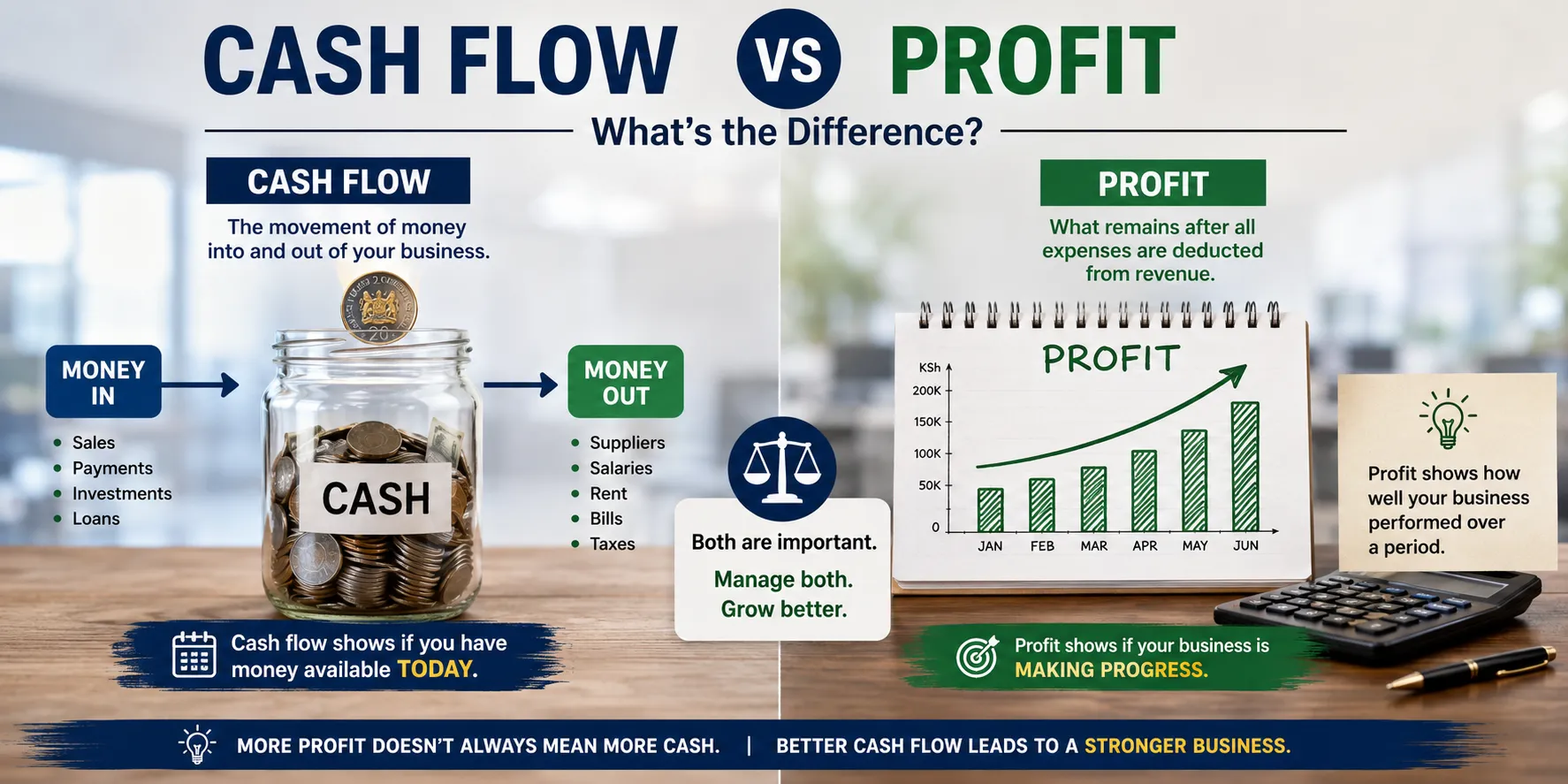
When the Bank Account Says "Zero" but the Business Is "Profitable"
A small electronics shop in Eldoret had just finished its best month of the year. Sales were up. Customers were buying laptops, phones, and accessories. Looking at the income statement, the owner had every reason to smile—the business had made a healthy profit.
Three weeks later, he couldn't pay a supplier on time.
How does a profitable business run short of cash?
That question surprises many entrepreneurs. In Kenya, especially among small and medium-sized businesses, confusing profit with cash flow is one of the fastest ways to create financial stress. The two are closely related, yet they tell completely different stories about a business.
Understanding that difference can help you make better decisions long before money problems begin.
1. What Is Profit?
Profit is what remains after subtracting all business expenses from total revenue.
If your shop sells goods worth KSh 1,000,000 in a month and all expenses—including stock, rent, salaries, transport, and taxes—add up to KSh 850,000, your profit is KSh 150,000.
On paper, the business is performing well.
Profit answers one simple question:
"Did the business earn more than it spent?"
That's why investors, banks, and business owners often look at profit when measuring long-term performance.
Still, profit doesn't tell you whether you have enough money available today.
2. What Is Cash Flow?
Cash flow tracks the actual movement of money into and out of the business.
It records cash received from customers and cash paid to suppliers, employees, landlords, utility companies, lenders, and everyone else.
Picture a hardware store that supplies building materials to contractors.
The store records KSh 500,000 worth of sales in June because the goods have already been delivered. The contractors, however, will only pay after 60 days.
Those sales increase profit immediately.
The cash doesn't arrive until August.
Until then, the owner still needs money to buy new stock and pay workers.
That's cash flow in action.
3. Profit Looks Back. Cash Flow Shows Today's Position.
One useful way to separate the two is to think about timing.
Profit measures business performance over a period.
Cash flow tells you whether money is actually available right now.
Imagine driving from Nairobi to Kisumu.
Your fuel gauge represents cash flow.
The total distance travelled represents profit.
You may be making good progress toward your destination, but without fuel, the journey stops.
Businesses work the same way.
4. Why a Profitable Business Can Still Run Out of Cash
This catches many business owners by surprise.
Several situations create this problem.
Customers Pay Late
Many businesses give credit to clients.
The sale is recorded immediately, but payment may take one, two, or even three months.
Meanwhile, operating expenses continue every week.
Too Much Money Is Locked in Stock
A supermarket may fill its shelves with products before the festive season.
Sales are expected later.
Until customers buy those products, the cash remains tied up in inventory.
Loan Repayments
Loan repayments reduce the cash available in the bank account.
Some portions of those repayments do not reduce accounting profit in the same period, yet the money still leaves the business.
Buying Equipment
Suppose a printing business purchases a new machine for KSh 2 million.
That payment immediately reduces available cash.
Profit is affected differently because the equipment is usually depreciated over several years rather than treated as a single expense.
In practice, many owners only notice the cash shortage after writing the cheque.
5. A Simple Example
Consider two businesses during the same month.
| Item | Business A | Business B |
|---|---|---|
| Sales | KSh 500,000 | KSh 500,000 |
| Profit | KSh 80,000 | KSh 80,000 |
| Cash received from customers | KSh 500,000 | KSh 150,000 |
On the surface, both businesses earned exactly the same profit.
The difference appears inside the bank account.
Business A collected payment immediately.
Business B sold mostly on credit.
Business B may struggle to pay salaries despite reporting healthy profits.
That's why cash flow often determines whether daily operations continue smoothly.
6. Why Business Owners Should Monitor Both
Some entrepreneurs focus only on monthly profits.
Others only check the bank balance.
Neither approach gives the complete picture.
Profit tells you whether the business model works.
Cash flow tells you whether the business can survive day to day.
Ignoring either one creates blind spots.
A company may have plenty of cash because it recently received a loan, yet still be making losses every month.
The opposite can also happen—a profitable company may face constant cash shortages because customers rarely pay on time.
Both situations deserve attention.
7. Reality vs Theory
Business textbooks often suggest that growing sales automatically improve financial health.
However, on the ground, growth can actually increase pressure on cash.
A wholesaler that lands several large contracts may suddenly need extra inventory, more delivery vehicles, and additional staff before receiving payment from customers.
Sales increase.
Profit improves.
Cash becomes tighter.
Many fast-growing businesses discover this lesson the hard way.
Growth without careful cash planning can create more stress than slow, steady expansion.
8. Practical Ways to Improve Cash Flow
Business owners don't always need to increase profits first.
Sometimes they simply need better cash management.
A few practical habits make a noticeable difference:
- Send invoices immediately after delivering goods or services.
- Follow up on overdue payments instead of waiting for customers to remember.
- Avoid buying more stock than the business can realistically sell.
- Negotiate supplier payment terms where possible.
- Keep a cash reserve for emergencies.
- Prepare a monthly cash flow forecast to identify shortages before they happen.
- Separate business money from personal spending to avoid unnecessary withdrawals.
These habits may sound ordinary, but they often prevent the financial pressure that catches many businesses off guard.
9. Which One Matters More?
There's no winner.
Profit and cash flow answer different questions.
Profit measures success over time.
Cash flow measures survival today.
A business needs both.
Think of profit as the score at the end of the match.
Cash flow is the stamina that keeps the team playing until the final whistle.
Without enough stamina, the score becomes irrelevant.
Final Thoughts
Many businesses don't fail because customers disappear or products stop selling. They struggle because cash arrives too slowly while bills continue arriving on schedule.
Knowing the difference between profit and cash flow changes how you look at financial reports. One tells you whether the business is creating value. The other tells you whether the lights stay on next week.
Business owners who watch both figures are usually better prepared for unexpected expenses, delayed payments, and periods of rapid growth. That doesn't eliminate every financial challenge, but it gives them a clearer picture of what's really happening inside the business—something every entrepreneur, from a market trader to the owner of a growing company, can benefit from.


